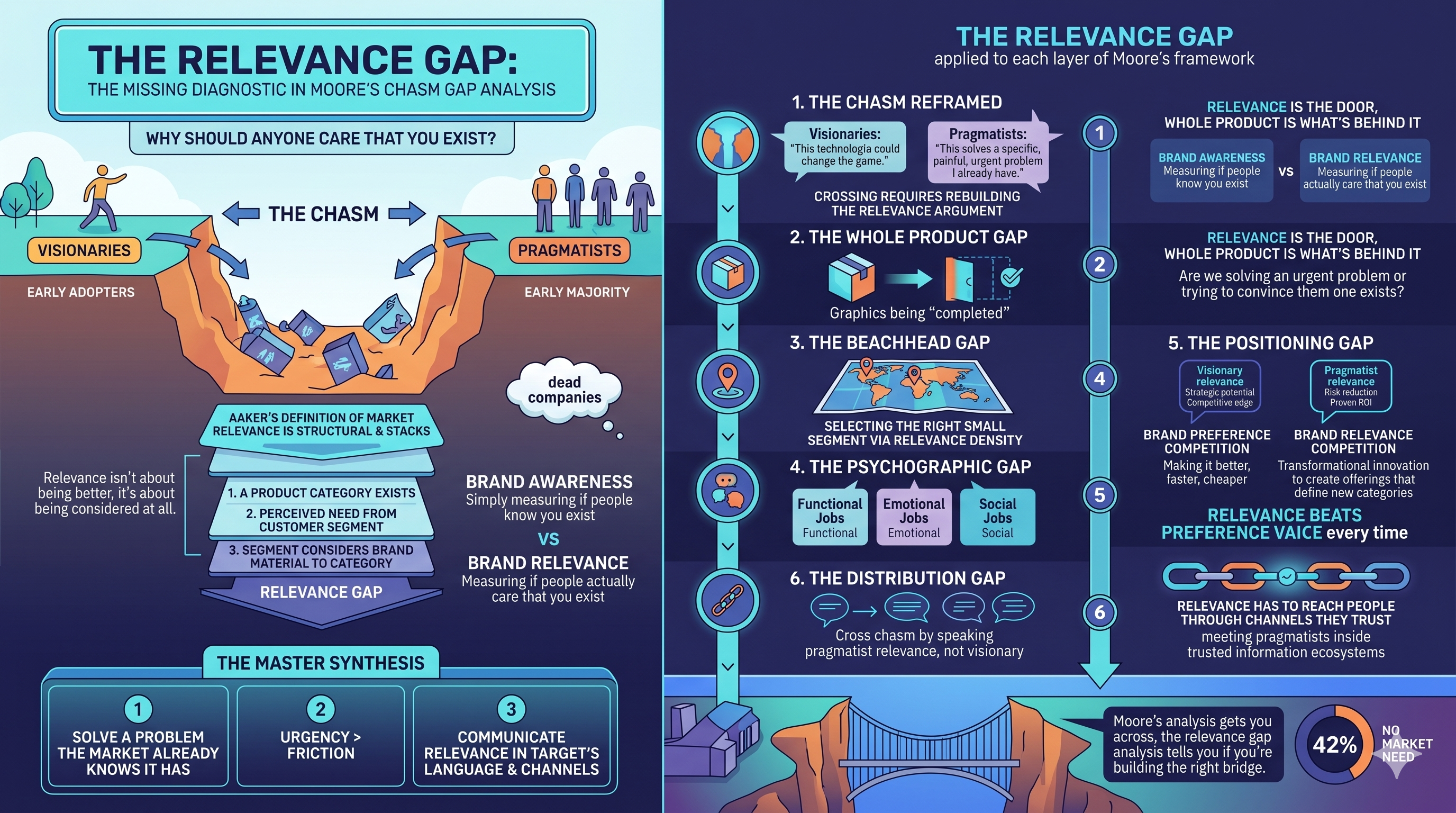
There’s a Gap in His Gap Analysis
Moore mapped the terrain brilliantly. He named the chasm, defined the psychographic gulf between visionaries and pragmatists, built the whole product concept, and gave us the beachhead strategy. Every framework in his gap analysis is real and actionable.
But there’s a gap in his gap analysis.
Underneath every one of Moore’s diagnostic layers sits an unanswered question that determines whether any of the other gaps even matter:
That is the relevance gap. And it precedes everything else.
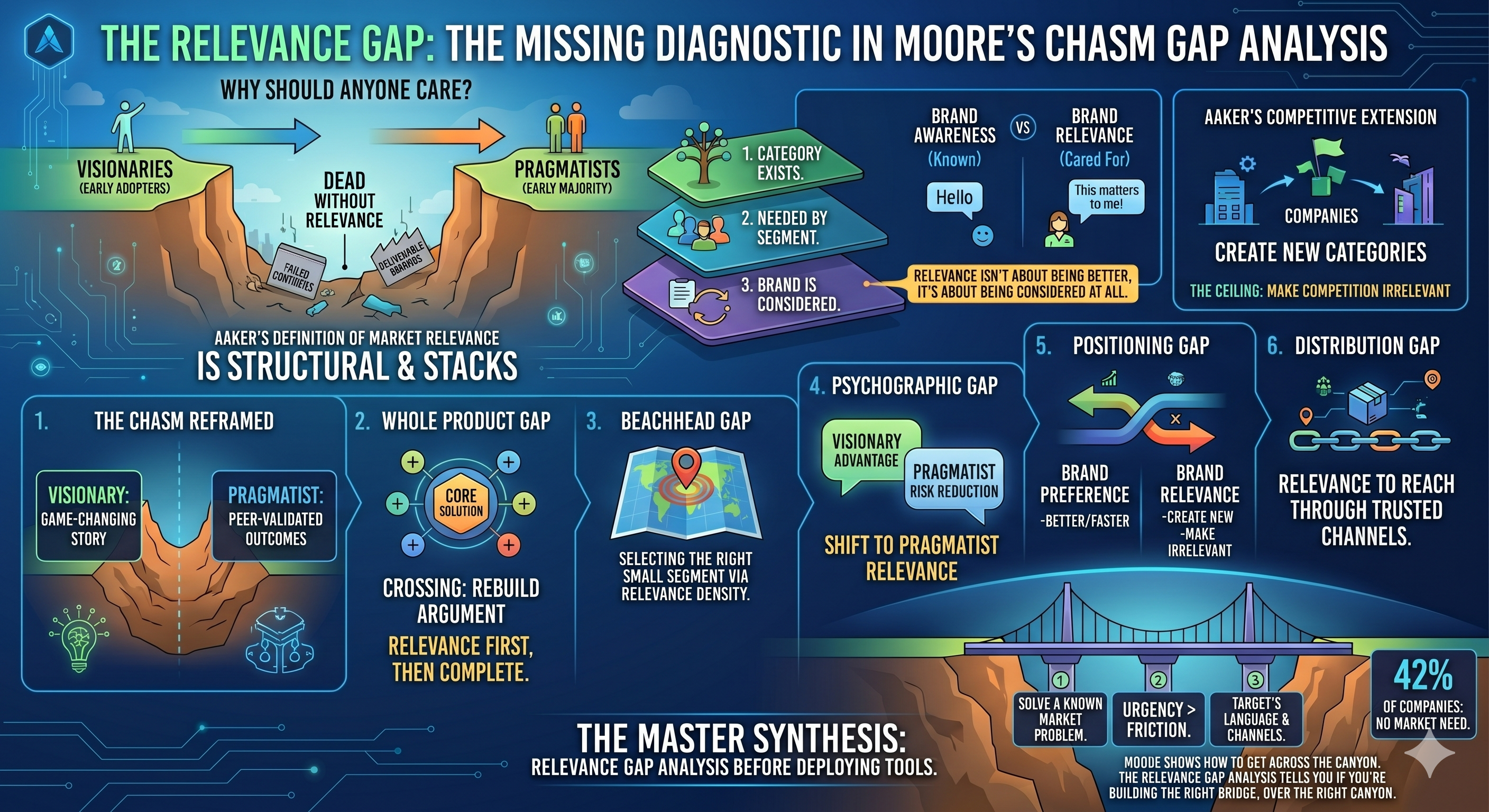
This Isn’t One Definition — It’s Several, and They Stack
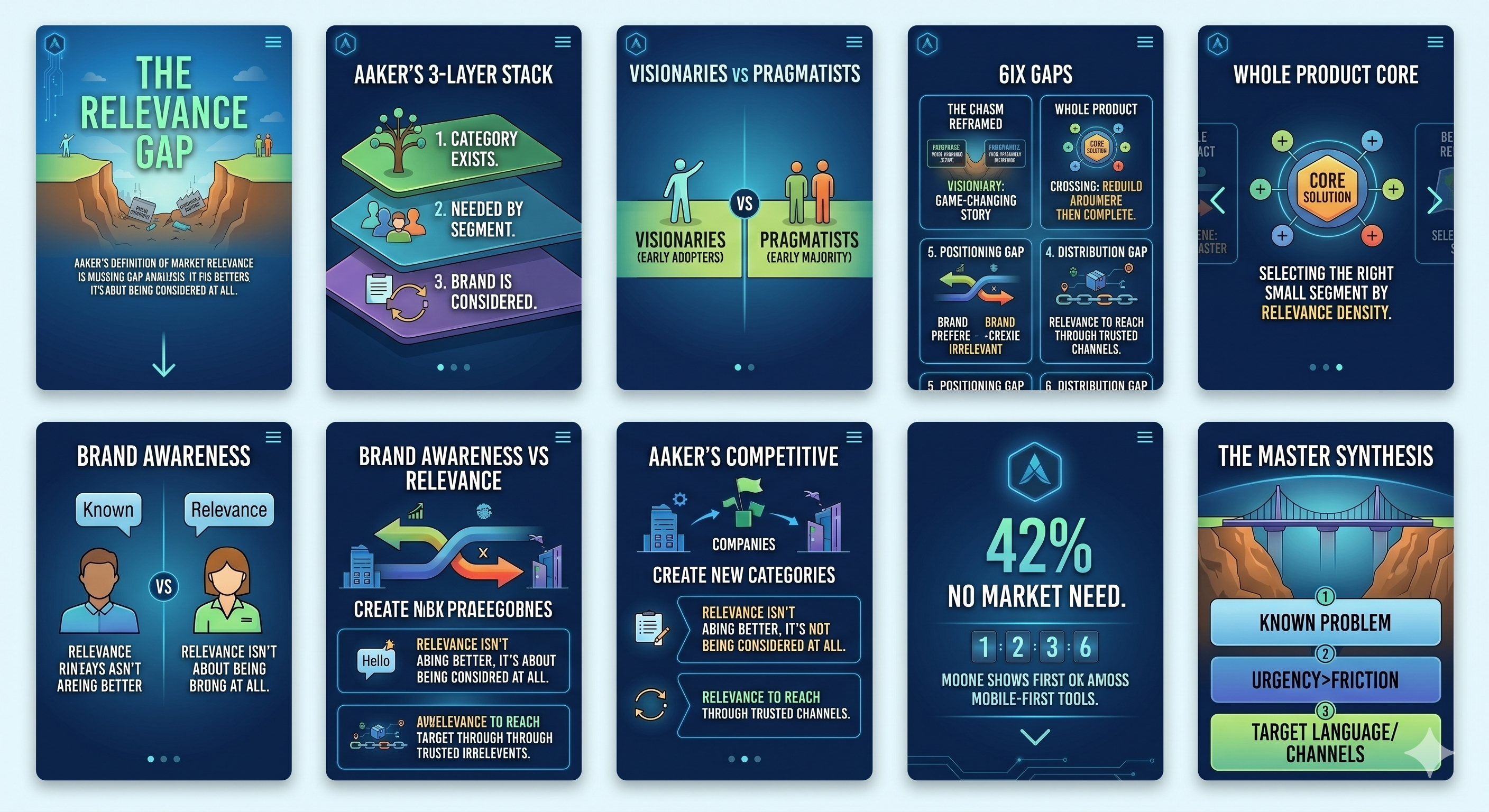
David Aaker’s structural definition is the most precise. For a brand to be relevant it must meet all three of the following conditions:
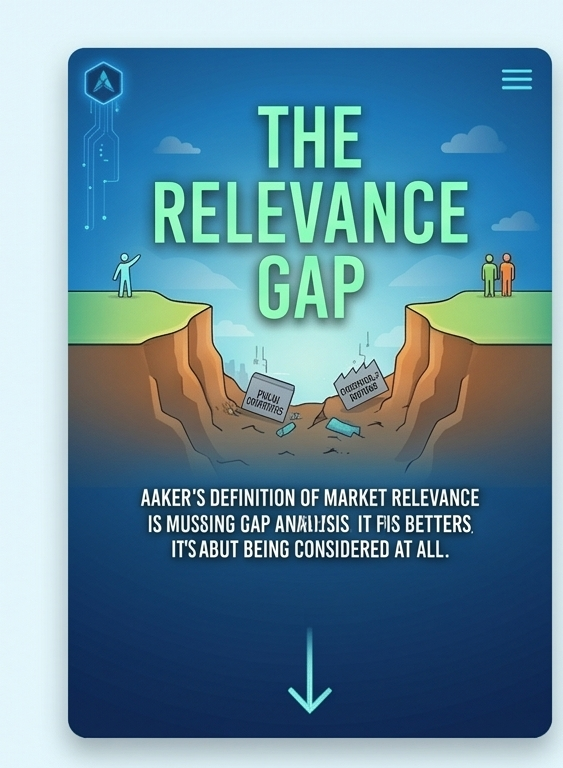
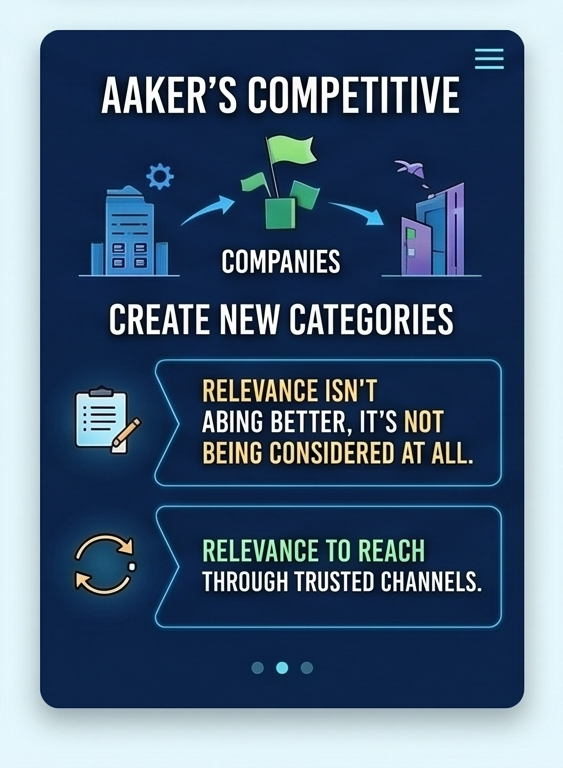
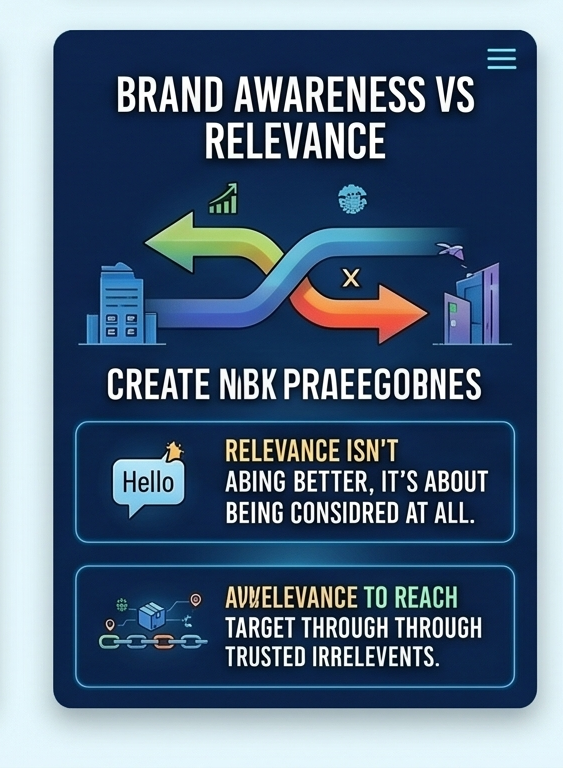
Note what Aaker is saying: relevance isn’t about being better. It’s about being considered at all. A brand will be relevant if it is included in the consideration set for a target category or subcategory and if that category or subcategory precipitates the decision. Both conditions are needed. If either is missing, the brand lacks relevance —
No amount of differentiation, positive attitudes, or brand-customer relationships will help.
David Aaker, 2004
That last sentence is a gut punch. No amount of differentiation will help. Moore’s entire positioning strategy is built on differentiation. If you haven’t earned relevance first, differentiation is noise.
Aaker’s competitive extension goes further. The brand relevance strategy involves transformational or substantial innovation to create offerings that define new categories or subcategories. The result can be a market in which there is no competition at all for an extended time. That’s the ceiling: not “we’re preferred” — but “we’re the only one that matters in this context.”
Unlike brand awareness, which simply measures if people know you exist, relevance measures if people actually care that you exist. People can know your name and not care. The chasm is full of companies that achieved awareness and died anyway.
“If no one is buying your product, it’s usually one of two things: there’s no product-market fit — you’re solving a problem no one cares enough about. Or you’re bad at sales — you have something valuable but can’t convince people to try it.” Both conditions are relevance failures. One is structural. One is communicative. Both are fatal.
Six Layers of Moore’s Framework — Seen Through the Relevance Lens
 The Chasm Itself
Reframed
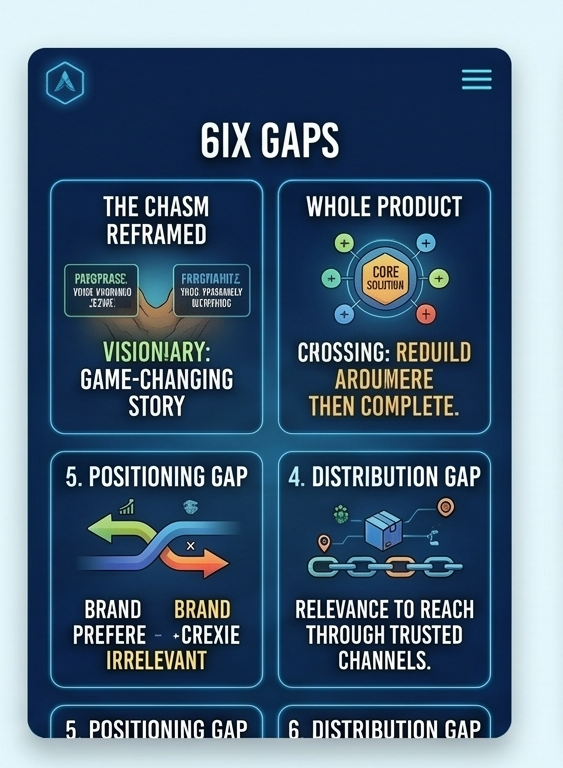
The standard explanation for why companies fall into the chasm is psychological: early adopters are visionaries, the early majority are pragmatists, and the psychographic mismatch kills deals. That’s accurate but incomplete.
The deeper reason the chasm exists is that visionaries and pragmatists define relevance completely differently.
The visionary defines relevance as: this technology could change the game for me. The pragmatist defines relevance as: this solves a specific, painful, urgent problem I already know I have, and I can prove to my colleagues that buying it was rational.
When a company crosses from early adopters to the mainstream without explicitly rebuilding its relevance argument, it fails not because the product changed — but because it’s speaking visionary relevance to pragmatist ears. The message lands as noise, not signal.
Have we explicitly rebuilt the relevance argument for pragmatists — or are we still speaking the language that won us visionaries?
 The Whole Product Gap
Relevance Is the Entry Condition, Not the Outcome
Moore’s whole product concept is about completing the solution. Map what you sell against what the customer needs to succeed, and close the gap. Powerful framework.
But the relevance gap sits upstream of it.
A pragmatist doesn’t evaluate your whole product gap if your core claim isn’t relevant to a problem they actively feel. Relevance is the door. The whole product is what’s behind it.
Even if a product technically solves a problem, it can fail because it doesn’t resonate emotionally with customers. A technically complete whole product built around a problem nobody is urgently experiencing is still irrelevant.
Is the problem we’re solving one that the target pragmatist segment already knows they have, already feels as urgent, and is actively looking for relief from — or are we trying to convince them the problem exists?
 The Beachhead Gap
Relevance Defines the Right Target, Not Just the Small Target
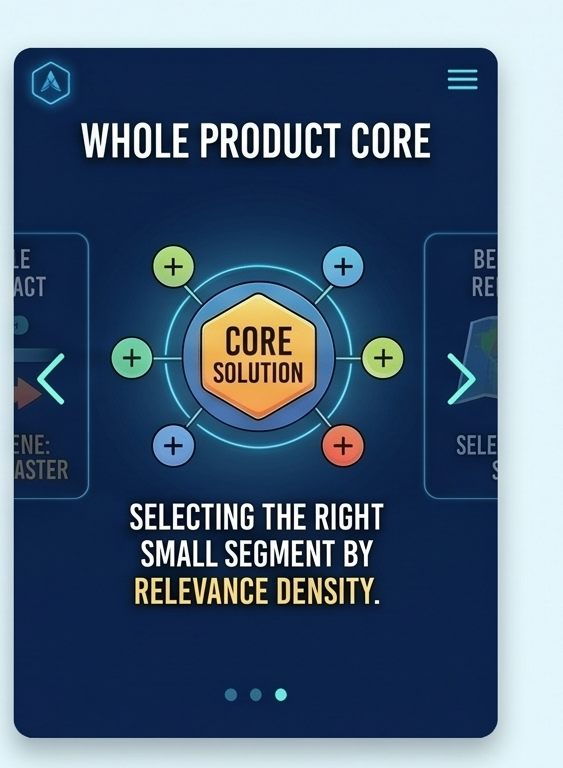
Moore tells you to pick a beachhead that is big enough to matter and small enough to win. Correct. But the selection criterion that determines whether you’ve picked the right small segment is relevance density — the concentration of people for whom your solution is not just useful, but urgent, obvious and inescapable.
The most potent beachhead is the one where your solution addresses all three simultaneously: functional jobs (core tasks customers want to get done), emotional jobs (how customers want to feel or avoid feeling), and social jobs (how customers want to be perceived by others).
A beachhead built purely on demographic or vertical criteria without relevance density will fail even if it’s appropriately small. You’ll win the segment numerically but generate no reference momentum.
Within our proposed beachhead, what percentage of prospects already feel this problem acutely enough to be actively seeking a solution — versus those who would consider our solution if sufficiently convinced?
 The Psychographic Gap
Relevance Is the Language, Not Just the Buyer Type
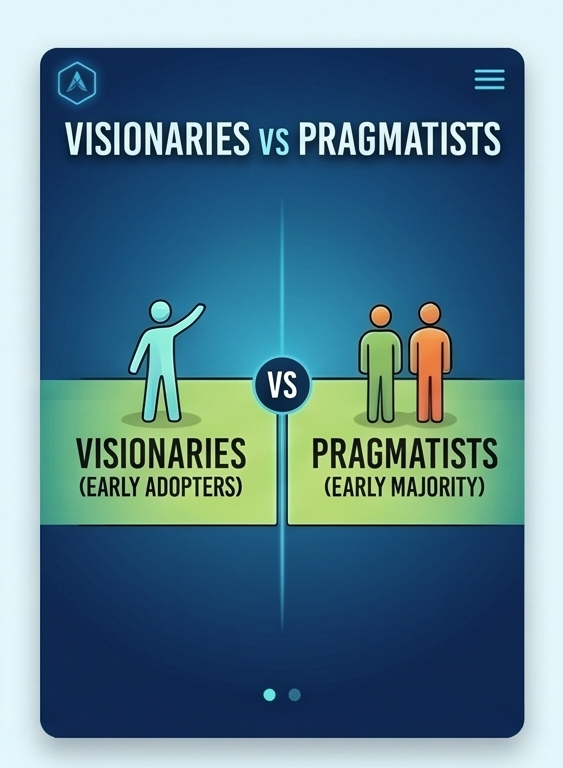
Moore identifies the psychological difference between visionaries and pragmatists precisely. Early adopters assess new technology at a technical level to determine if it can give them a strategic advantage. The early majority assess it based on reputation and references from peers.
The relevance gap at this layer is a language problem. Most companies crossing the chasm speak the wrong relevance dialect. They speak visionary relevance — strategic potential, transformational possibility, competitive edge — to pragmatist ears tuned for pragmatist relevance: risk reduction, peer validation, proven ROI, vendor stability.
The pragmatist’s relevance filter is: does this map to problems I already have budget to solve, people who will vouch for it, and a vendor I can defend choosing to my CFO? If your messaging addresses none of those, you are speaking in a language they don’t use to make decisions.
You are not irrelevant because your product doesn’t work. You are irrelevant because you haven’t translated your value into the currency they spend attention with.
Are we communicating in the dialect pragmatists use to make decisions — or in the dialect that won us visionaries?
 The Positioning Gap
Relevance Beats Preference Every Time
Moore says pragmatists want to buy from market leaders. To cross the chasm, you must claim and credibly own a leadership position in your chosen segment. Correct.
Aaker complicates this productively. In brand preference competition, the goal is to be superior in an established category — making it better, faster, cheaper. Brand relevance focuses on transformational innovation creating new categories and subcategories for which there is little or no competition.
Pursuing brand preference means constantly striving to be faster, cheaper and better — an endless battle where competitors quickly match improvements. With brand relevance, the goal is to make competition irrelevant — to offer something so different and special that it creates its own unique category.
Are we competing for preference within someone else’s category — or defining a new one where we are the only relevant option?
 The Distribution Gap
Relevance Has to Reach People Through Channels They Trust
Moore’s most counterintuitive point: distribution channel before revenue. The number-one corporate objective when crossing the chasm is to secure a distribution channel into the mainstream market, one with which the pragmatist customer will be comfortable.
The relevance gap at the distribution layer is channel trust. Pragmatists don’t just evaluate the product. They evaluate the source. If your product reaches pragmatists through a channel they don’t already trust — if it comes via a partner with no credibility in their vertical, or via marketing that reads as startup-speak rather than industry-native language — the message is irrelevant before it lands.
Channel relevance is about meeting pragmatists inside the information ecosystems they already inhabit and trust.
Are we reaching pragmatists through the analyst reports, peer networks, and industry publications they use to validate decisions — or through channels they associate with vendors trying to sell them something?
Run Relevance Gap Analysis Before Deploying Crossing Tools
Moore gave us the topography of the chasm. He showed you where the walls are, what tools to bring, and which beach to storm. That framework is correct.
The relevance gap is the question that should be asked before any of his tools are deployed. It has three parts:
Do you solve a problem the market already knows it has? Not a problem you’ve identified, not a problem you’ve convinced a few visionaries is real — a problem pragmatists in your target segment are already losing sleep over, already have budget conversations about, already using workarounds to manage.
Is the urgency of that problem proportional to the friction of adopting your solution? Relevance isn’t static — it’s a ratio. If the pain isn’t severe enough to justify the switching cost, the training burden, the integration risk, you are not relevant enough to the pragmatist’s calculation.
Can you communicate that relevance in the language, through the channels, and with the references that your target pragmatist segment uses to make decisions? A relevant solution communicated irrelevantly is still dead.
of startups reported their customers had no market need for their products. Those weren’t all bad products. Many were technically excellent. They failed the relevance test before the chasm ever came into view.
“Moore’s chasm gap analysis tells you how to get across the canyon. The relevance gap analysis tells you whether the bridge you’re building is the right bridge, in the right location, over the right canyon.”
Without relevance, there is nothing to cross.